LDTC 690
Capstone Project
Online Course Module
A new course module, titled “Speaking Effectively in a Job Interview,” was created to expand upon an interview preparation module (already developed for LDTC 650) for an online course to help job seekers prepare for job interviews. The initial module focused on interview preparation models and guided students on creating and sharing strong, measurable anecdotes in interviews. The new module created during this project for LDTC 690 continued the course and focused on developing strong speaking skills.
The new “Speaking Effectively in a Job Interview” module teaches students to confidently and fluently answer interview questions. Interview preparation and practicing mock interviews improves confidence, reduces anxiety, and boosts readiness for real job interviews, while helping candidates deliver clear, concise answers without rambling tangents or filler words (Anaza et al., 2023).
Being able to successfully complete a job interview is critical in obtaining employment, but simply memorizing stock answers is not enough to be fully prepared (Plung, 2024). Job seekers can become stressed and nervous during a live interview, jeopardizing their chances at getting their dream job (Ali et al., 2022).

Learning Needs: According to the National Center for Science and Engineering Statistics (NCSES), approximately 153 million workers were employed in the U.S. as of 2022, with ~23% of employed workers in STEM occupations (36 million people) (2025).
Job seekers need to excel at job interviews to be able to receive job offers and advance their careers. Beyond simply memorizing answers, they must learn strategies for presenting themselves confidently, responding to questions clearly and concisely, and demonstrating their unique value to potential employers. Many candidates struggle with nerves, lack of preparation, or difficulty articulating their experiences in a way that aligns with job requirements.
Job seekers face a variety of challenges in job interviews. For example, sub-baccalaureate STEM job seekers often need to translate a diverse mix of non-degree credentials into clear, job-relevant value, as they may encounter bias favoring degrees unless they can demonstrate concrete skills and outcomes (NCSES, 2025). Interview prep should therefore include training on structured storytelling, portfolio-ready examples, and ROI-focused narratives that map each credential to specific job requirements and measurable results.
Research also indicates that observable authenticity cues influence perceptions of genuineness and can impact both interview and job performance (Heimann & Schmitz-Wilhelmy, 2025). At the same time, interview experts warn against being “too authentic” and coming across as overly casual or inappropriate in interviews (Chamorro-Premuzic, 2025). Because of these complexities, job seekers should practice in a structured way to best improve their job chances.
Opportunities: This course offers opportunities for participants to develop practical interview skills, practice effective communication, and become more comfortable answering interview questions, helping them overcome common challenges and improve their chances of success in real interview settings. The course will teach sound interview preparation techniques and strategies, which can help job seekers become more confident and be better prepared for real job interviews (Anaza et al., 2023).
Here is an overview of common root causes of failures in job interviews, based on years of direct experience working with interview coaching clients:
Poor Speaking Skills: Some job seekers may be great at their jobs but simply lack the verbal articulation or presentation skills required to clearly convey their competence to an external party.
Insufficient Preparation: Candidates often struggle because they fail to adequately prepare for the interview environment, leading to visible nerves and unclear communication.
Nerves Cause Mistakes: Simple errors or “flubbing” of answers frequently occur when high anxiety causes candidates to lose composure during questioning.
Inability to Articulate Value: Many fail to translate their past experiences into clear, concise narratives that directly demonstrate their unique value proposition relevant to the specific job requirements.
Failure to Demonstrate Measurable Impact: Candidates often miss the opportunity to frame their accomplishments using tangible results or a clear Return on Investment (ROI) perspective.
Misalignment of Authenticity and Professionalism: Job seekers find it challenging to balance being genuine and authentic with maintaining the level of professional formality expected in an interview setting.
The following performance gaps are culled from direct experience coaching hundreds of job seekers in interview preparation:
Inability to clearly articulate accomplishments:
· Struggling to explain specific achievements or contributions in past roles.
· Difficulty using measurable results or concrete examples to illustrate success.
· Tendency to provide vague or generic statements rather than impactful stories.
Rambling and excessive talking:
· Answers are often too lengthy or unfocused, making it hard for interviewers to follow key points.
· Lack of concise responses leads to loss of interviewer’s interest.
· Difficulty getting to the main point quickly and efficiently.
Overuse of filler words (e.g., “uh,” “um”):
· Frequent use of filler words reduces professionalism and confidence.
· May indicate nervousness or lack of preparation.
· Distracts from the content of the answer.
Freezing or blanking before answering:
· Becoming silent or visibly anxious when unsure how to answer.
· Trouble gathering thoughts under pressure during interviews.
· May result in incomplete or off-topic answers.
Fidgeting and distracting body language:
· Unconscious movements such as tapping, shifting, or playing with objects.
· Poor eye contact or closed-off posture undermines confidence.
· Body language that distracts from the spoken message.
Bringing up inappropriate or irrelevant topics:
· Sharing too much personal information unrelated to the job or interview question.
· Discussing sensitive or off-topic subjects that may be unprofessional.
· Difficulty staying focused on job-relevant experiences and skills.
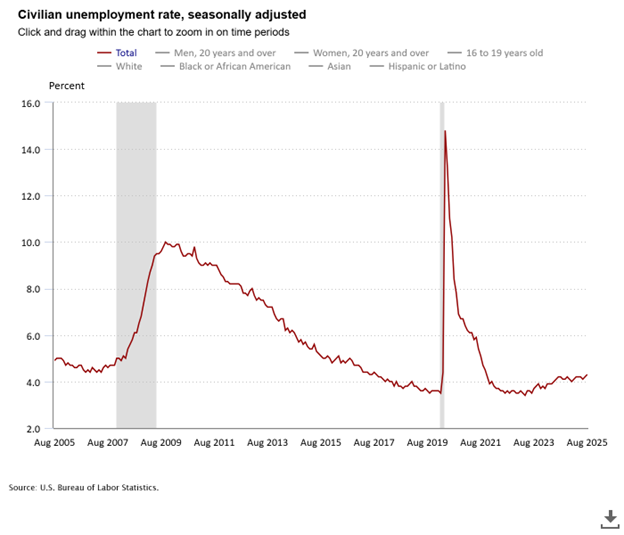
In the United States, the unemployment rate can fluctuate between 4 and 10% or more, with crises such as the 2008 financial crisis and 2020 COVID-19 pandemic causing unemployment spikes (U.S. Bureau of Labor Statistics, 2025).
The primary target for the interview preparation course is any average person looking for a job, especially those unemployed. However, employed people often look for jobs as well for career enhancement. The course is thus targeted to a wide variety of people, with the exception of certain specialized populations, such as people overcoming serious hardships such as homelessness or leaving prison, who can benefit from more tailored programs. While this interview preparation course should be helpful to almost all (and it will be accessible), the primary target audience is motivated professionals who would be willing and able to purchase a reasonably priced interview course.
The following personas have been developed as aggregate people from 5+ years of experience in interview coaching:

Occupation: VP of Finance seeking C-level role
Demographics: 59-year-old male, newly divorced, not planning on retiring
Education: MBA, Certified Public Accountant (CPA)
Concerns: Age discrimination and reverse discrimination (against white males) are major concerns after being passed over for multiple jobs.

Occupation: Homemaker; Goal: Administrative Assistant
Demographics: 47-year-old female, empty nester
Education: High school diploma
Concerns: Returning to workforce after two decades raising children.

Occupation: Data Analyst
Demographics: 23-year-old male, single, no kids
Education: Bachelor of Science in Data Science
Concerns: Just graduated with a bachelor’s degree and has never had a formal job interview.

Occupation: Shipping & Logistics Manager
Demographics: 42-year-old male, married, 2 kids
Education: Associate of Applied Science (A.A.S.) in Logistics Management, Certified in Production and Inventory Management (CPIM)
Concerns: Doesn’t know what to say during an interview. Tends to freeze and stop talking abruptly.

Occupation: Epidemiologist
Demographics: 32-year-old female, engaged
Education: Master of Public Health (MPH) in Epidemiology
Concerns: Talks way too long. Gets overly technical and rambles on in answers.

Occupation: Non-Profit Program Manager
Demographics: 39-year-old female, married
Education: Master of Education in Advanced Teaching, pursuing a Ph.D. in Sociology
Concerns: Has accomplished a lot in diverse roles but doesn’t know how to share this with a hiring manager.
My role in developing the “Speaking Effectively in a Job Interview” module was both as subject matter expert and instructional designer. I used my years of experience as an interview coach to design content that addressed the specific needs of job seekers striving to communicate confidently and concisely during interviews.

Drawing from the challenges I have observed—such as candidates speaking for too long, becoming overly technical, or losing focus—I carefully structured the module to include practical frameworks, real-world examples, and interactive exercises. These elements were intended to help learners recognize and avoid common pitfalls while articulating their skills and experiences clearly.
In addition, I strove to align the instructional strategies with the overall learning objectives of the project, ensuring that the module would be engaging, accessible, and effective for a diverse audience. My dual perspective enabled me to bridge content expertise with best practices in instructional design, ultimately producing a learning experience tailored to empower participants to excel in job interviews.
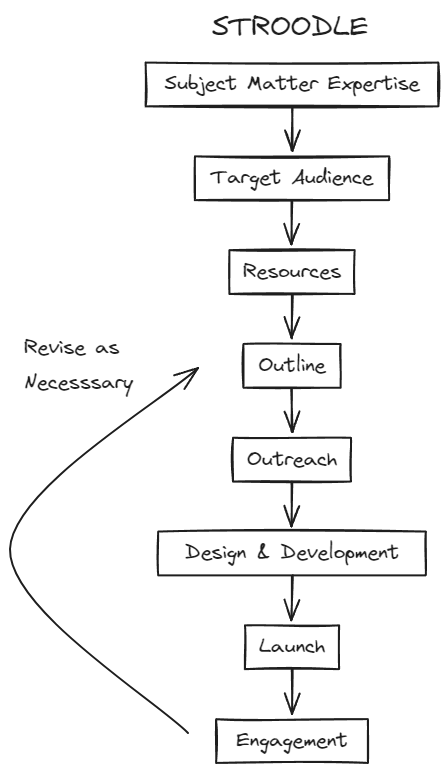
I developed a unique instructional design model called STROODLE, specifically tailored for solopreneurs, small business owners, influencers, and thought leaders who are building online courses independently. While STROODLE draws inspiration from the established ADDIE framework, it refines and simplifies key steps—such as breaking down “Analysis” into manageable components—and introduces essential marketing stages designed to support the commercial success of courses offered by small enterprises and individual creators. (STROODLE graphic created by Stephanie Brail.)
· Subject Matter Expertise – Clearly define the specific niche and identify the SME(s) needed to drive course content. (In most cases, this will be the solopreneur/influencer.)
· Target Audience – Identify precisely who the course is for and narrow down by relevant characteristics or segments.
· Resources – Assess the tools, platforms, skills, and support needed to create and deliver the course. Begin organizing these tools, connecting with contractors (if necessary), and obtaining any necessary technology licenses and/or resources.
· Outline – Draft a high-level course structure with modules, learning outcomes, and key selling points.
· Outreach – Plan and start pre-launch promotion using the course outline to pre-sell the course and build interest. Create a course marketing plan.
· Design & Development – Create all course materials, such as videos, slides, and handouts, aligned with course goals.
· Launch – Open enrollment to the public and execute the marketing plan to drive sign-ups.
· Engagement – Stay connected with students, gather feedback, and improve the course based on their experience.
The Notion MCP (Module Content Platform) was set up as a base of operations to write, collect, and organize content prior to being produced and launched in the Learning Management System (LMS). Handouts, videos, and other audiovisual content were built based upon the base text content. Generate AI tools are used to help create and edit content. Once the content was ready, it was placed in the LMS (Canvas).
Main Workflow: Base Text -> PowerPoint Slides -> Videos -> AI Video Transcripts / TTS Audio of Text -> Discussion Prompts -> Quiz -> Handouts -> Interactive Elements -> Launch to LMS
The final learning solution consisted of 9 lessons with the following features: a text overview (with audio version), short video segments with transcripts, captions, and AI summaries, an interactive “AI Interview Coach” chatbot, a video interview experience, a low stakes quiz, discussions, and related handouts.
The course is modular and can be installed on any modern commercial LMS solution.
The following is a list of the tools and technologies used to develop the course module:
· Balabolka – Text-to-Speech
· Canvas – Learning Management System (LMS)
· Generative AI – Text and Image Creation
· HireVire – Video Interview Experience
· Microsoft Word – Document Creation and Editing
· Notion – Staging Area
· Orimon – AI Chatbot
· PowerPoint – Slide Deck
· Publitio – Content Delivery Network (CDN)
· Vento – Video Recording & Editing
· WhisperTranscribe – Video Captions and Transcripts
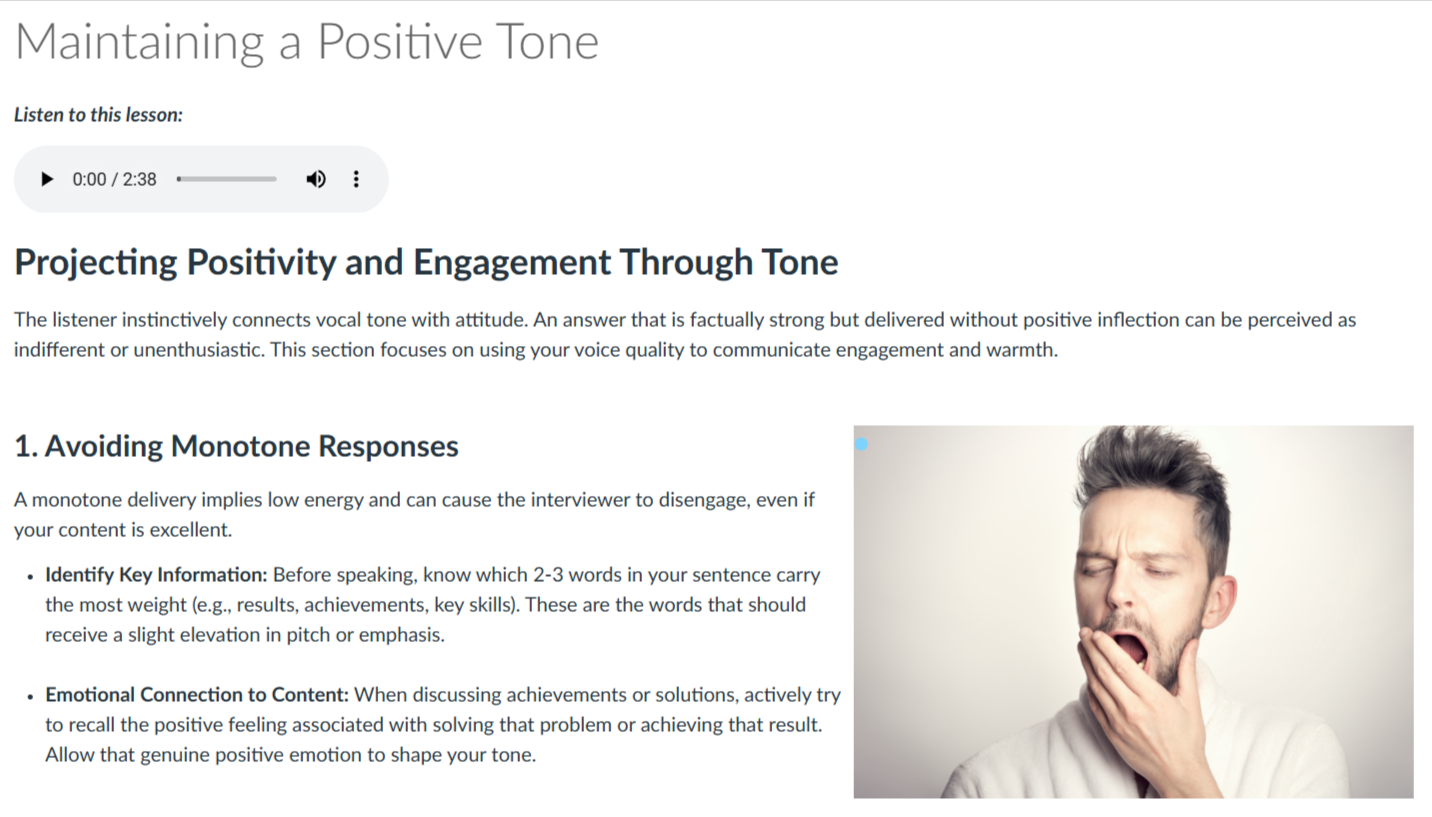
The following screenshot shows a portion of the lesson “Maintaining a Positive Tone.” The lesson includes an audio version made with AI text-to-speech technology, and a video lesson (included on the following page).
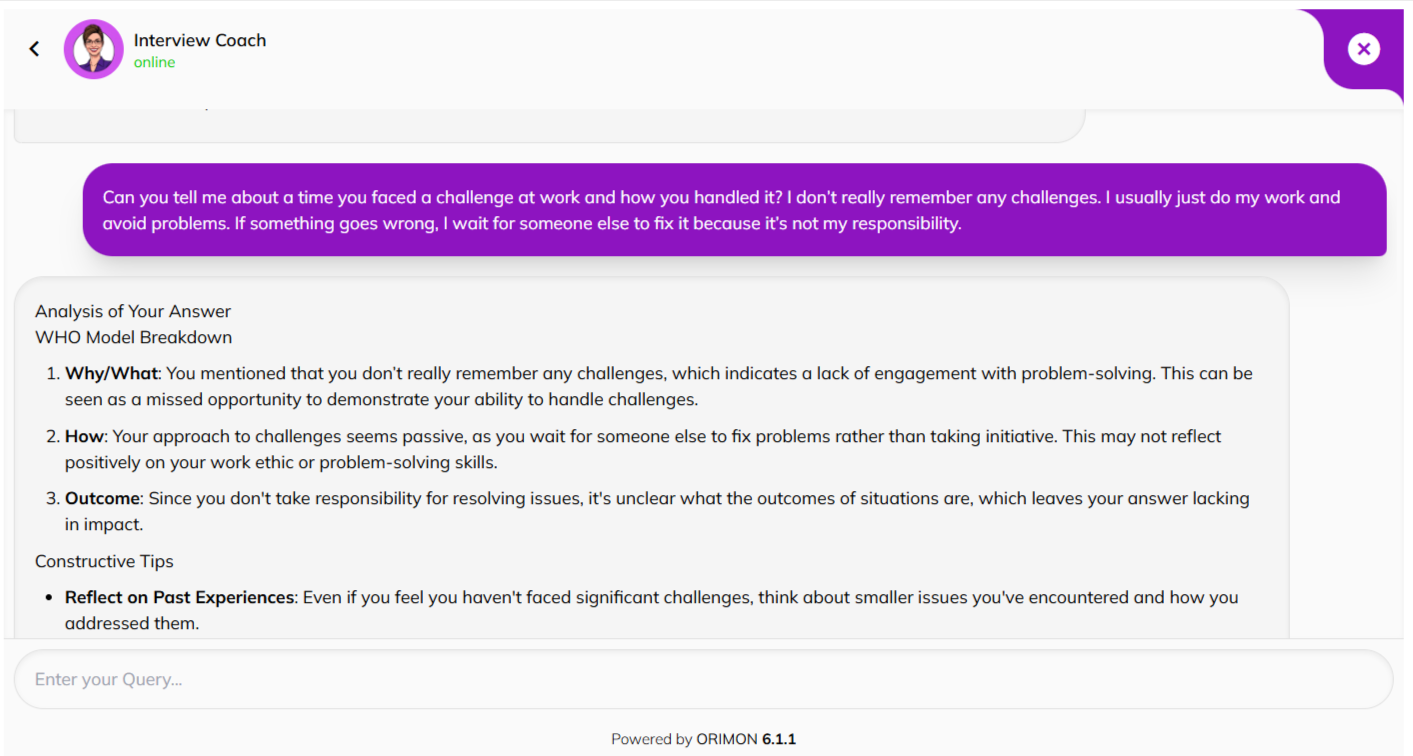
The following screenshot shows an example interaction with a custom-trained AI chatbot that is designed to at as an interview coach. Students can enter in an interview question and answer, which is then analyzed by the AI using the WHO framework developed by the course instructor.
Looking back on the development and launch of the “Speaking Effectively in a Job Interview” module, I feel a genuine sense of accomplishment. This project expanded on my earlier work for LDTC 650, moving beyond interview preparation models to focus on helping students develop strong speaking skills. The goal was to empower learners to answer interview questions confidently and fluently, and I believe the module succeeded in delivering that. Through guided practice and mock interviews, students gained tools to reduce anxiety, boost readiness, and deliver clear, concise answers while avoiding rambling or filler words.

The most rewarding aspect was seeing the module come together, especially given the tight timeline. Despite the pressure, I managed to create a cohesive learning experience that addressed real needs. Feedback from a trusted friend, who is dyslexic and sometimes struggles with reading, was especially meaningful. They found the AI-generated audio lessons easy to follow and even preferred them to a real voice in some cases. Knowing that my efforts to make the content accessible paid off was a highlight of the project.
Of course, the process wasn’t without its challenges. One of the biggest lessons I learned is that everything takes longer than expected—especially if you want to do it right. Even tasks that seem simple, like creating audio versions of lessons, required careful attention. I had to listen to each AI-generated rendition, troubleshoot mispronunciations, and experiment with alternative spellings to get the output just right.
The module may not be visually flashy, but the amount of labor involved in aligning all the details—stock photos, layout consistency, spacing—was extensive. Most users won’t consciously notice these efforts, but they make a difference in the overall experience.
In hindsight, I may have taken on more than was realistic for the timeframe. If I were to do it again, I’d put tighter constraints on the scope and interactive elements to ensure a more manageable workload.
This capstone experience taught me the importance of valuing my own time and energy. I realized that I must not underestimate the effort required to produce quality work, nor should I undersell myself. As I move into instructional design consulting, I’ll be upfront with clients about time and cost estimates, making sure I’m compensated fairly and not overextending myself.
Another major takeaway is the value of technological skills. My comfort with tools like AI was instrumental in completing the project efficiently. For example, I trained an AI chatbot for students, and leveraged generative AI for content creation. These skills are increasingly critical for instructional designers, and I’m confident that curating AI output will be a major part of the field’s future. Without generative AI, I wouldn’t have been able to finish the module in such a short time.
Based on feedback, I see opportunities to further refine the module—perhaps by splitting content into two separate modules, with body language and camera advice expanded in a new section. This iterative approach will help ensure the course remains relevant and effective.
This project has truly shaped my perspective on what it means to be an effective instructional designer. By navigating the challenges of scope, time management, and accessibility, I’ve learned to approach future projects with a more strategic mindset—setting realistic boundaries and prioritizing the learner experience. The hands-on experience with AI tools and audio accessibility reinforced the importance of leveraging technology to meet diverse learner needs. Moving forward, I’ll carry these lessons into my professional practice, ensuring that I advocate for my own time and expertise, communicate transparently with clients, and continue to innovate with technology.
I’m confident that these skills and insights will help me design impactful, accessible learning experiences and adapt to the evolving demands of the instructional design field.
Ali, A. M., Sayeed, M. S., Hossen, M. J., & Muhammad Amer Ridzuan, B. Z. (2022). Stress detection during job interview using physiological signal. International Journal of Electrical and Computer Engineering, 12(5), 5531-5542. https://doi.org/10.11591/ijece.v12i5.pp5531-5542
Anaza, E., Mabrey, P., Sato, M., Miller, O., & Thompson, J. (2023). Improving student interview preparation through collaborative multimodal mock-interview assignments. Sport Management Education Journal, 17(2), 164–176. https://doi.org/10.1123/smej.2021-0021
Chamorro-Premuzic, T. (2025, February 15). 7 common mistakes you should avoid during job interviews. Forbes. https://www.forbes.com/sites/tomaspremuzic/2025/02/15/seven-common-mistakes-you-should-avoid-during-job-interviews/
Heimann, A. L., & Schmitz-Wilhelmy, A. (2025). Observing interviewees’ inner self: How authenticity cues in job interviews relate to interview and job performance. Journal of Business and Psychology, 40(1), 237–256. https://doi.org/10.1007/s10869-024-09949-4
Hirevire. (n.d.). How it works: Video screening software for efficient recruitment. Hirevire. Retrieved 28 October 2025, from https://hirevire.com/how-it-works
National Center for Science and Engineering Statistics (NCSES). (2025). New pilot data on the prevalence of work-related credentials among STEM workers from the National Training, Education, and Workforce Survey (NSF 25-352). National Science Foundation. https://ncses.nsf.gov/pubs/nsf25352
Plung, D. (2024). Job interview preparation: A practical exercise in the rhetoric of oral argument. Business and Professional Communication Quarterly, 87(1), 177–193. https://doi.org/10.1177/23294906221142541
U.S. Bureau of Labor Statistics. (2025, August). Civilian unemployment rate. U.S. Bureau of Labor Statistics; U.S. Bureau of Labor - Office of Employment and Unemployment Statistics. https://www.bls.gov/charts/employment-situation/civilian-unemployment-rate.htm
AI Usage: AI was used to help rewrite, edit, and improve content.